How to Choose the Right Gate Repair Company in San Francisco
The right gate repair company in San Francisco is one that specializes in gates exclusively, employs certified technicians with factory training on your specific brand, and can diagnose problems on-site rather than from photos. Look for owner-operated businesses with documented brand certifications, on-site parts capability, and deep familiarity with San Francisco’s permit landscape—not general contractors who list gates as one of twenty services. If you’d rather skip the vetting process and speak with a specialist now, call us at (628) 261-6223 for a free estimate.
Last month we were called to a home in Noe Valley where a company with 400 Google reviews and a polished website had “repaired” the same gate twice—first replacing a motor that wasn’t the problem, then swapping a control board that didn’t need replacing. Steven diagnosed the actual issue, a failed limit switch in a FAAC 770 slide gate operator, in about twenty minutes. They weren’t incompetent; gates were roughly 10% of their business, and they were running through a generic troubleshooting checklist written for garage doors. In San Francisco’s competitive market, that distinction—specialist versus generalist—determines whether your gate gets fixed once or three times.
Specialist vs. Generalist: How to Tell From a Website
San Francisco homeowners have dozens of gate repair options, but most companies advertising gate services are actually general contractors, fence installers, or garage door companies that added “gates” to their menu. Here’s how to spot the difference before you call.
Check the service menu first. A true gate specialist’s website will lead with gate-specific categories: swing gate repair, slide gate repair, gate motor and opener service, access control systems, gate welding and structural repair. If “gates” appears between “deck staining” and “HVAC maintenance,” you’re looking at a generalist. Look for brand-specific language too—mentions of LiftMaster gate operators, FAAC hydraulic systems, or Viking telephone entry systems—not generic phrases like “all makes and models.”
Review the photo gallery. Specialists photograph gate operators, access control keypads, and welded hinge repairs. Generalists show fence panels and garage doors with a gate somewhere in the background. In our 31 years working on gates exclusively, we’ve learned that the mechanical and electrical complexity of automated gates—high-voltage operators, loop detectors, safety edge sensors—requires a completely different skill set than carpentry or fencing.
Finally, read how they describe their technicians. “Experienced technicians” means nothing. Look for specifics: years of gate-only experience, factory certification programs, named brands the technician is authorized to service. At Liberty Gate Repair San Francisco home, Steven Lee serves as both owner and lead technician, meaning the person who answers your questions is the same one diagnosing and fixing the gate.
Why Owner-Operated Gate Companies Outperform on Diagnosis
There’s a structural reason owner-operated gate companies in San Francisco tend to get diagnoses right the first time, and it comes down to accountability and repetition.
In a franchise or multi-trade operation, the technician who arrives is often an employee following standardized protocols designed for volume, not nuance. They’ve been trained to handle forty different service types, and their incentive is to close tickets quickly. When a gate problem is intermittent—say, a Linear actuator that stalls only when temperature drops below 50 degrees, which happens regularly in San Francisco’s Sunset District mornings—they’re likely to replace the obvious component and move on.
An owner-operator like Steven has personally handled thousands of gate failures across San Francisco’s microclimates. He’s seen how salt air near the Marina accelerates corrosion in Mighty Mule control boxes, how the steep grades in Pacific Heights stress Viking swing gate hinges differently than flat installations, how DoorKing telephone entry systems in SOMA condo buildings fail from electrical noise in dense urban environments. That pattern recognition—built over 31 years—doesn’t transfer through employee training manuals.
The financial structure matters too. When Steven misdiagnoses a gate, he absorbs the cost of the return visit and the replacement parts. There’s no corporate layer insulating him from the mistake. That direct accountability sharpens diagnostic precision in ways that commission-based technicians for national franchises rarely match.
Brand Certification: What to Ask For and What It Proves
Gate and operator manufacturers don’t hand out certifications to anyone with a truck and tools. Factory-authorized technician programs require hands-on training, examination, and ongoing education. Here’s what the major programs verify and how to check them.
- LiftMaster: Their ProVantage dealer program certifies technicians on commercial and residential gate operators, including safety protocol training. Ask for a ProVantage dealer number.
- FAAC: Italian hydraulic systems require specialized knowledge. FAAC’s technician certification covers hydraulic fluid systems, pressure settings, and European safety standards—substantially different from electromechanical operators.
- BFT: Another European manufacturer with specific certification for their underground and articulated arm operators, common in high-end San Francisco residential installations.
- Linear: Offers factory training on their full operator line, including the popular Linear Pro Access series used in many Bay Area commercial properties.
- Viking, Ghost Controls, DoorKing, Elite, Mighty Mule: Each maintains technician authorization programs, though requirements vary. Viking and DoorKing emphasize commercial access control integration; Ghost Controls and Mighty Mule focus on residential DIY-to-pro transitions.
Here’s the test: ask the company which specific models they’ve certified on in the past year. A technician genuinely familiar with your brand will name models—”the FAAC 844, the LiftMaster CSW24U, the Viking L-3″—not just the brand. We maintain active familiarity with all nine brands because San Francisco’s architectural diversity means we encounter everything from historic wrought-iron swing gates with modern Elite operators to new BFT underground systems in Presidio Heights renovations.
The On-Site Assessment: Steps That Can’t Be Skipped
A proper gate diagnosis requires physical presence. Any company offering firm quotes from photos or video calls is cutting corners you’ll pay for later. Here’s what legitimate assessment looks like.
First, the technician should test all inputs: remote controls, keypad codes, telephone entry systems, vehicle loop detectors, and manual release functions. Each input path fails differently, and skipping any means missing intermittent faults. We recently found a Ghost Controls system in the Richmond District that worked fine on remote but failed on keypad—a wiring fault invisible from any photo.
Second, mechanical inspection: hinge wear, track alignment, wheel bearing condition, gate balance and drag. A gate operator rated for 800 pounds that’s pushing 950 due to binding hinges will fail prematurely, and replacing the operator without fixing the mechanics wastes your money.
Third, electrical testing: voltage at the operator under load, amperage draw during operation, safety edge and photo eye function, loop detector sensitivity. These require meters, not eyes.
Fourth, structural evaluation: post stability, concrete footing condition, gate frame integrity. In San Francisco’s earthquake country, we’ve found gates that “needed a new motor” actually needed welded frame reinforcement—something no photo diagnosis catches.
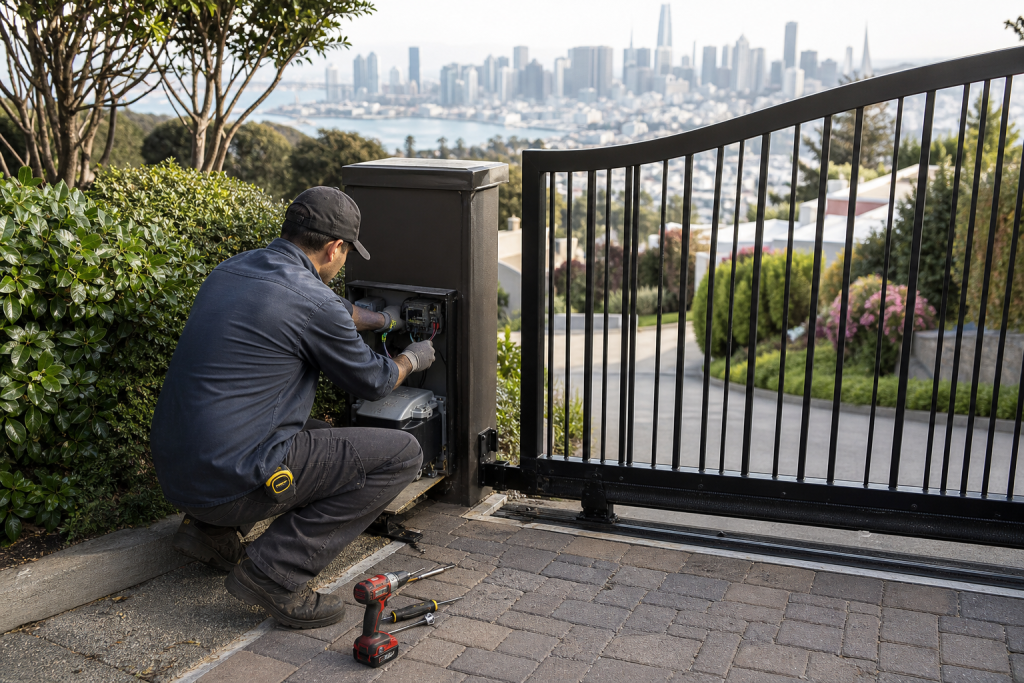
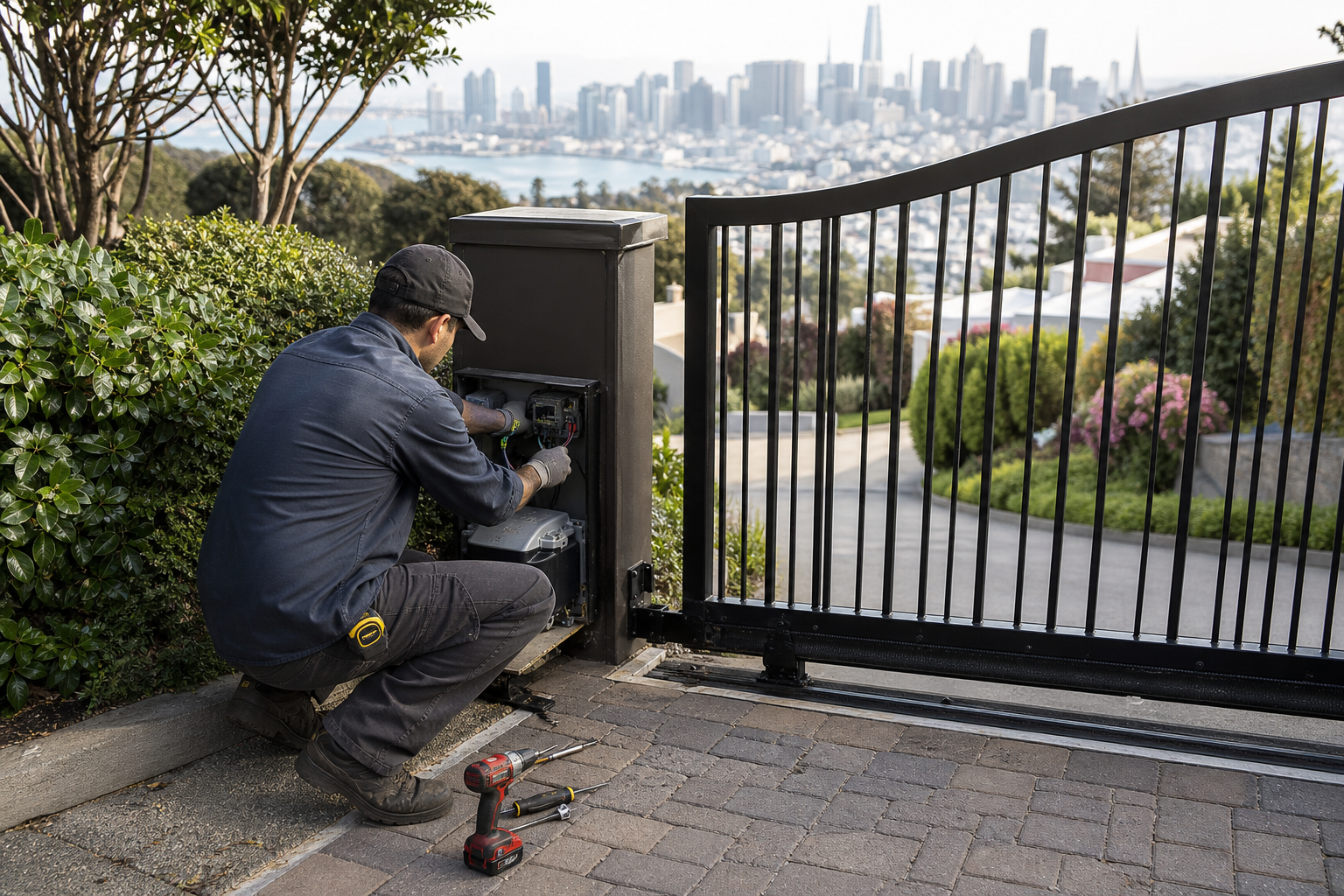
If a technician walks up, glances at the gate, and announces the problem without running these checks, you’re getting a guess, not a diagnosis. We stock parts and weld on-site specifically so we can complete the full repair in that single visit, not return after ordering parts based on a hunch.
Testing Local Expertise: San Francisco Permit and HOA Knowledge
San Francisco’s regulatory environment separates local gate specialists from out-of-town contractors who happen to service the city. Here’s a test question that reveals genuine local knowledge.
Ask: “My HOA requires gate modifications to meet specific safety standards, and the city inspector has flagged my installation. How do you handle that?”
A local specialist will discuss San Francisco’s specific requirements: Department of Building Inspection permits for structural gate modifications, compliance with California’s automatic gate safety standards (ASTM F2200 and UL 325), coordination with HOA architectural committees common in complexes like the St. Francis Wood or Diamond Heights developments. They’ll know that San Francisco inspectors often require separate electrical permits for low-voltage access control wiring, and that historic district properties may need additional review.
A generalist will likely stumble, offer to “look into it,” or suggest you handle permits yourself. That’s a red flag. In our experience, permit and HOA complications derail more San Francisco gate projects than technical problems do. We’ve worked directly with local inspectors on hundreds of installations, and we know which interpretations vary by inspector—which saves weeks of back-and-forth.
Related services: If you’re evaluating gate options beyond repair, we also handle Gate Installation in Stockton and Gate Motor & Opener in Stockton for properties in that region.
Key Takeaways: Spotting the Right Gate Company in San Francisco
- True specialists lead with gate-specific services and brand names, not generic “we fix everything” menus
- Owner-operated companies carry direct accountability that improves diagnostic accuracy
- Factory certifications on your specific brand prove technical competence, not just general “experience”
- On-site assessment with mechanical, electrical, and structural testing is non-negotiable
- Local permit and HOA knowledge prevents project delays and compliance failures
- Review volume matters less than review specificity—look for detailed mentions of your gate type or brand
When to Call a Pro
If your gate is making unusual noises, moving unevenly, failing to respond to controls, or showing visible structural wear, it’s time for professional assessment—especially if the gate is automated, as electrical and mechanical faults compound quickly. Delaying typically turns a $200 adjustment into a $1,200 operator replacement. In San Francisco’s security-conscious market, a non-functional gate also leaves your property exposed longer than necessary.
The Bottom Line
Choosing the right gate repair company in San Francisco comes down to one question: does this business live and breathe gates, or are gates a side service? The answer reveals itself in their website depth, brand certifications, diagnostic process, and local regulatory fluency. Credentials and review counts are easy to acquire; 31 years of gate-exclusive pattern recognition is not.
At Liberty Gate Repair San Francisco, we’ve built our reputation on being the specialist’s specialist—Steven diagnoses it, Steven fixes it, and we stock parts and weld on-site to finish in one visit. Our 613 customers rated us 4.9 stars not because every job was simple, but because we identified the actual problem and solved it without callbacks.
If you’re evaluating gate repair companies and want a second opinion—or you’re ready to schedule service—call (628) 261-6223 for a free estimate. We’ll assess your gate on-site, explain what we find in plain language, and give you upfront pricing before any work begins.
Frequently Asked Questions
Most residential gate repairs in San Francisco range from $180 for minor adjustments and safety sensor realignment to $850 for operator replacement or structural welding. Commercial access control repairs typically run higher due to system complexity. The exact cost depends on your gate type, brand, and whether the problem is mechanical, electrical, or structural. Call (628) 261-6223 for a free on-site estimate—we’ll diagnose the specific issue and give you upfront pricing.
Repair is almost always cheaper if the gate frame and posts are structurally sound. A quality steel or aluminum gate frame can last 30+ years with proper hinge, track, and operator maintenance. Replacement becomes the better value when you’re facing extensive corrosion, multiple failed welds, or an operator that’s been discontinued and unsupported for years. We evaluate this honestly on every call—there’s no benefit to us in replacing a gate that we can repair properly. Call (628) 261-6223 and we’ll assess which path makes financial sense for your specific situation.
Most established gate specialists in San Francisco can schedule within 1–3 business days for non-emergency repairs; emergency service for security-compromising failures may be available same-day depending on the company. Response speed varies significantly by season and by whether the company is owner-operated or dispatching employees from a central call center. We prioritize calls where the gate is stuck open or completely inoperable, as these create genuine security exposure. For our current availability in your San Francisco neighborhood, call (628) 261-6223.
Ask these five questions: What brands are you factory-certified to service? Will the technician who diagnoses the gate also complete the repair? Do you stock parts and have welding capability on your service vehicle? What does your on-site assessment include—mechanical, electrical, and structural checks? How do you handle San Francisco permits and HOA requirements? The specificity of their answers will tell you whether you’re speaking with a specialist or a generalist. If you’d like to ask us these questions directly, Steven Lee is available at (628) 261-6223.
Reviewed by Steven Lee, Owner & Lead Technician at Liberty Gate Repair San Francisco, serving San Francisco since 1995.
Need Gate Repair Help?
Call Liberty Gate Repair San Francisco — licensed & insured, here with fast after-hours help in San Francisco.
(628) 261-6223